

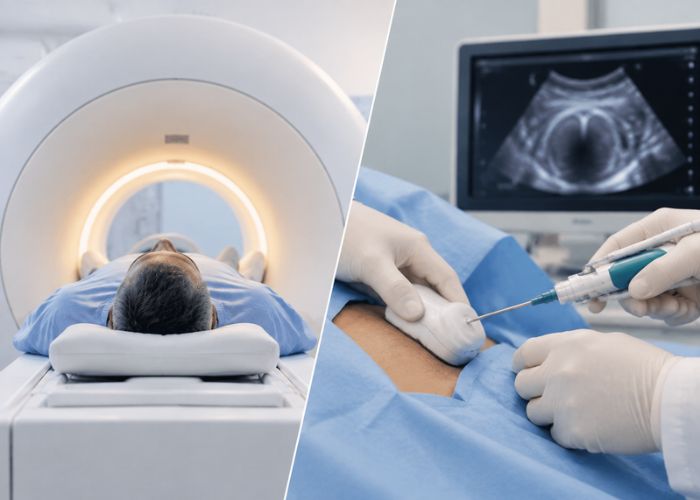
When prostate cancer is suspected, one of the first questions patients often ask is whether they should have an MRI or a biopsy first. In most cases today, doctors prefer to perform a prostate MRI before an initial biopsy. The reason is simple: an MRI can show suspicious areas inside the prostate and help doctors decide whether a biopsy is really needed and, if it is, where tissue samples should be taken.
However, MRI results are only one part of the decision. The best urologist in Mumbai will also consider PSA levels, PSA density, examination findings, family history, age, and overall prostate cancer risk before recommending the next step.
Current European Association of Urology guidelines support performing MRI before prostate biopsy when organ-confined prostate cancer is suspected. MRI does not replace biopsy, but it can make the diagnostic process more focused and accurate.
A prostate MRI, usually called a multiparametric MRI or mpMRI, provides detailed images of the prostate using different imaging sequences. It allows doctors to look for areas that appear unusual and may represent clinically significant prostate cancer.
It can also provide useful information about prostate size, surrounding tissues, and whether a suspicious lesion appears confined to the prostate.
Radiologists usually report prostate MRI findings using the PI-RADS scoring system, which ranges from 1 to 5. Lower scores suggest a lower chance of clinically significant cancer, while higher scores indicate greater suspicion.
The best urologist in Mumbai does not rely on the PI-RADS score alone. It is interpreted along with PSA results, PSA density, physical examination findings, and individual risk factors.
A prostate MRI may help doctors:
One important point is that MRI cannot confirm prostate cancer. It can show suspicious areas, but it cannot examine prostate cells directly.
A prostate biopsy involves removing small samples of prostate tissue so they can be examined under a microscope by a pathologist.
Unlike MRI, biopsy can confirm whether prostate cancer is actually present. It also provides important information about the type and grade of cancer, which helps doctors plan treatment if cancer is detected.
A transperineal biopsy is performed through the skin between the scrotum and anus. A transrectal biopsy is performed through the rectum.
When MRI results are available, doctors can target areas that look suspicious rather than taking samples only from predetermined locations.
Depending on the findings, the best urologist in Mumbai may recommend a targeted biopsy, systematic biopsy, or a combination of both.
For many men being investigated for possible localized prostate cancer, MRI is now performed first.
This approach gives doctors more information before deciding whether tissue sampling is necessary. It can also help them target suspicious areas more accurately during biopsy.
The best urologist in Mumbai may recommend MRI first when PSA remains elevated, PSA density is concerning, the prostate examination is abnormal, or there are other risk factors for prostate cancer.
An MRI-first approach does not mean every patient can avoid biopsy. Instead, it helps doctors decide which patients are more likely to benefit from biopsy and where samples should be taken.
Sometimes, yes.
If MRI does not show any suspicious lesions and the patient’s overall cancer risk is low, doctors may decide to monitor the patient rather than perform an immediate biopsy.
However, a negative MRI does not completely rule out prostate cancer. Some clinically significant cancers may not be clearly visible on imaging.
Because of this, the best urologist in Mumbai will usually consider several factors before deciding whether biopsy can be avoided.
These include:
If these factors suggest that the risk remains significant, biopsy may still be recommended even when MRI findings are reassuring.
When MRI identifies a suspicious area, biopsy is usually the next step.
The main advantage of having MRI before biopsy is that doctors know exactly where suspicious tissue is located. This makes it possible to take targeted samples from the areas most likely to contain clinically significant cancer.
Several methods can be used for targeted biopsy, including MRI-ultrasound fusion, cognitive targeting, and direct MRI-guided biopsy.
The choice depends on available technology, the location of the lesion, and the doctor’s experience.
The best urologist in Mumbai may also take systematic samples from other parts of the prostate. This is because clinically important cancer may occasionally be present outside the main lesion seen on MRI.
MRI and biopsy answer different questions.
MRI helps doctors understand where suspicious areas are located and how likely they are to represent significant cancer.
Biopsy provides actual prostate tissue that can be examined under a microscope. This is what confirms whether cancer is present and helps determine its grade.
For this reason, MRI and biopsy should not really be seen as competing tests.
In many cases, the best urologist in Mumbai uses MRI first to assess risk and guide the next step. If the MRI or other clinical findings remain concerning, biopsy is then performed to obtain a definitive diagnosis.
For many men being investigated for suspected localized prostate cancer, yes. MRI is commonly performed before biopsy because it can identify suspicious areas and help guide targeted tissue sampling. The best urologist in Mumbai will also consider PSA, PSA density, examination findings, and overall risk.
No. MRI can show areas that look suspicious, but it cannot confirm cancer on its own. A biopsy is needed when doctors require tissue confirmation under a microscope.
A negative MRI means no suspicious lesion was clearly identified. This lowers the likelihood of clinically significant prostate cancer, but it does not eliminate the risk completely. The best urologist in Mumbai may recommend monitoring or biopsy depending on other risk factors.
PI-RADS 4 and 5 lesions have a higher level of suspicion for clinically significant prostate cancer. In these situations, doctors commonly recommend a targeted biopsy to obtain tissue and confirm the diagnosis.
Both methods can provide reliable tissue samples. Transperineal biopsy is increasingly used because it generally has a lower risk of infection. The best urologist in Mumbai will recommend the approach that is most suitable for the individual patient.
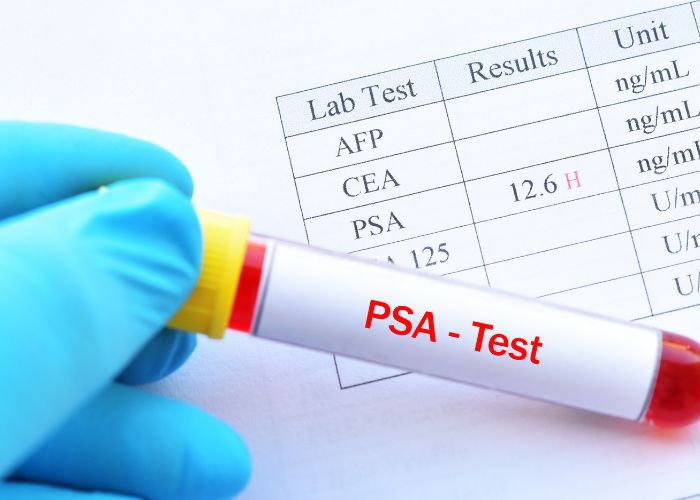
No. PSA can rise for several reasons, including prostate enlargement, inflammation, infection, or recent prostate manipulation. Doctors may repeat the PSA test, calculate PSA density, perform an MRI, or assess other risk factors before recommending biopsy.
There is no fixed timeline for everyone. The timing depends on the MRI findings, PSA results, symptoms, medications, overall health, and level of cancer risk. The best urologist in Mumbai will decide the appropriate timing based on the complete clinical picture.

Dr. Mangesh Patil is a renowned Urologist, and is trained in Endourology and Robotic Surgery , with professional experience of more than 10 years .
© 2024 – Urocare Clinic. All Right Reserved | Maintained By Rebecca Digital